
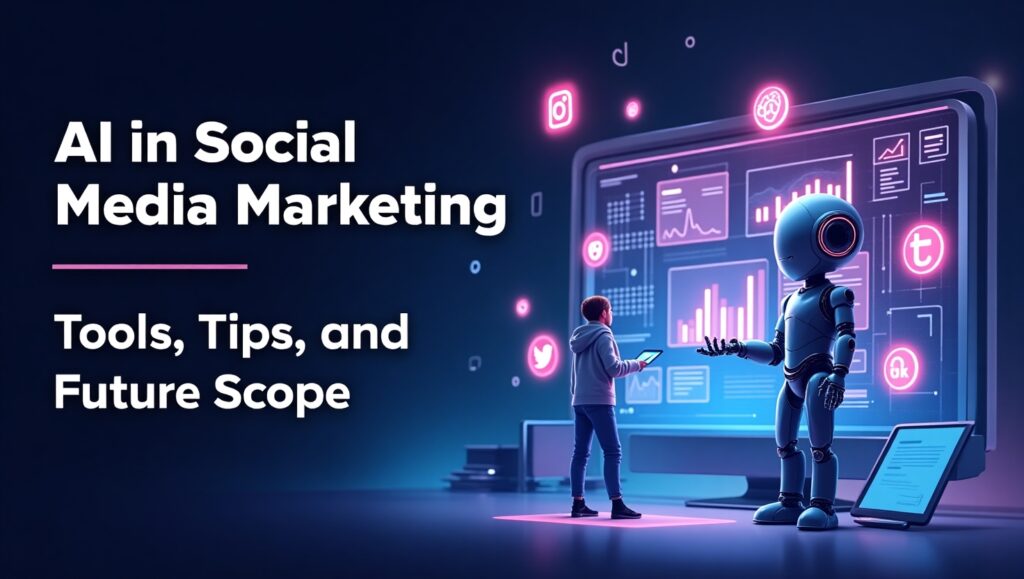
In an era where social media platforms evolve at lightning speed, marketers are challenged to create timely content, engage the consumer contextually, and measure success even faster. There is more competition, less attention span, and one technology has surfaced to help brands keep up with the pace and complexity of marketing today: Artificial Intelligence (AI).
Artificial Intelligence is no longer a narrative of the future and the realm of tech titans and hacktivists. The year 2025 saw levels of AI become mainstream and necessary for the daily work of organizations ( and all organizations within the defined space of a social media marketing strategy). It has begun to change the engagement dynamics for consumers on the web, changing everything from autonomous content creation, predicting user behavior, and optimizing ad campaigns in real-time for targeting.
AI is a game-changer in social media marketing – it is not just an enabler. AI gives brands the ability to gain enhanced insights about their customers, provide hyper-personalized experiences, and make smarter decisions based on data. AI technologies can perform analysis on billions of social data points into seconds to figure out what is working, what is not working, and maybe even what is happening next.
Whether it’s creating clever captions, measuring audience sentiment, using chatbots to automating customer service, posting during peak performance hours – AI is streamlining every step of social media. Best of all, it allows marketers to have more time to do strategic and creative work while AI handles the tedious, time-consuming time suck in the background.
But even more challenges and questions also come with the new advantages of AI: How are you supposed to use it responsibly? Can it replace the human aspect of creativity? What does the future look like as AI continues to evolve?
In this post, we will break down the power of AI in social media marketing, the best tools available for current use, actionable strategies to incorporate AI into your workflow, and what the future holds. And whether you’re a novice or experienced marketer, using AI effectively will give you a competitive advantage in the ever-evolving digital world.
How AI Is Changing the Social Media Landscape
How AI is Changing the Future of Social Media
In 2025, artificial intelligence (AI) has transitioned from an emerging technology to a key component in digital marketing strategies (and especially social media). AI is not just enhancing how brands operate with the never-ending influx of content, growing expectations from users, and need for real time interaction, it’s fundamentally transforming the face of social media.
Here’s a breakdown of the most impactful areas AI is currently impacting:
1. Intelligent content generation
One of the biggest challenges with social media marketing is creating new, impactful content consistently. AI-based writing tools like ChatGPT, Jasper, and Copy.ai are game-changers. These applications can automatically generate a large variety of content such as:
- Interesting social media captions
- Ad copy for advertisements
- Longer posts
- Video scripts and reels descriptions
Using natural language processing (NLP), AI content generation tools understand tone, context, and intent, which allow marketers to create content that is most likely to resonate with their audience without taking hours of their time!
2. Image and Video Editing Changes
Graphic content is the heart of social media engagement, and in today’s scenario, AI is simplifying the whole process! For example, Canva Magic Studio leverages AI to:
- Suggest layout changes
- Remove backgrounds automatically
- Build branded design elements
- Generate images from text
Similarly, Pictory and Lumen5 are changing the way that marketers create video. Rather than creating videos with a camera, they can convert blog posts or scripts into what looks like a professional video using AI to suggest scenes, content, voiceover, and stock video footage – perfect for Instagram Reels, TikToks, and YouTube Shorts.
3. Hyper-personalized Audience Segmentation
Finding the right audience and delivering the right messages is what social media marketing is all about, and the beauty of AI is that it is making this process exponentially easier! AI algorithms can make observations based on user behavior, interests, location, previous behavior, etc., to build profiles of a given audience.
Gaming and social media apps such as Facebook (Meta) and LinkedIn use AI as part of micro-targeting users so advertisers can provide content that is uniquely catered to them. A great example of this is dynamic personalized advertisements, where different users can even see different versions (iterations) of the same advertisement based on user interests or activities.
4. Real-Time Ad Optimization
AI has changed the landscape of paid advertising on Google Ads Instagram, and TikTok because platforms now use AI and machine learning for:
- Automatically optimizing ad delivery in real-time
- Optimizing bidding and budgets, in real-time
- Finding the best performers of ad creative variations
- Forecasting which are the most likely users to convert
Real-time optimization reduces wasted spend and maximizes return on ad spend (ROAS), even for smaller companies with limited budgets.
5. Real-Time Sentiment Analysis
Understanding what people are saying about your brand at the moment is a critical part of online reputation management. Sentiment analysis applications like Brandwatch, Sprinklr, and Hootsuite Insights track and analyze thousands of mentions, comments, and reviews for emotional tone (positive, negative, neutral).
This allows marketers to:
- Respond to negative press in real-time
- Find brand emergencies or trending topics before they become significant issues
- Identify opportunities for brand engagement
Understand the trajectory of what the public thinks about their brand, over time
With sentiment automation, companies can be reactive while maintaining a positive online image.
AI is not just an assistant for social media marketers, it’s an ally for marketing strategy. From content generation, advertising targeting, and sentiment tracking, AI encourages brands to experience smarter, faster, personalized experiences on every platform. As algorithms advance and tools become wiser, AI adoption in social media marketing will continue to gain momentum—and it is imperative that marketers educate themselves and apply new technology.
If you’re not leveraging social media marketing by this point, today is the day to begin. The future of social media is smart, for data-driven, personalized experiences, and with AI.
Top AI Tools for Social Media Marketing in 2025
The use of AI tools, which aren’t just enhancing social media marketing, are dominating social media marketing in 2025. Whether it’s content creation, customer interactions, or data analysis, AI-powered tools and platforms are helping marketers work smarter, scale faster, and have a more emotional connection to their audiences. Below are the most powerful and used AI tools that are transforming the social media marketing industry in 2025:
a) ChatGPT & Jasper
AI writing tools are becoming the go-to tool for social media managers and content creators. ChatGPT and Jasper, produce catchy and compelling captions, ad copy, blog post ideas, and even full content calendars in just a few seconds. Both Ai writing tools are helping social media managers and content creators produce engaging textual posts, in their brand voice, related to tone, topic and context.
b) Canva Magic Studio
while actively leveraging AI, Canava’s Magic Studio takes the artistry of generating visual content to a whole new level. There’s no question using its features like Magic Write (AI-generated text), AI remove background, andAI suggestion of images, you can create high-quality looking graphics, reels covers, and, carousel posts in minutes–and are ideal for your Instagram, Facebook and LinkedIn posts.
c) Lately.ai
Recently it has utilized AI to take long-form content (blog posts, podcasts, white papers etc.) and turn it into multiple social media snippets. It analyzes all past content to see what worked best, and creates various posts based on engagement across platforms—this is a huge time-saver and extends reach for a fraction of the time.
d) Pictory
Pictory is video-making AI software that takes written content and creates short, engaging motion video based on social media standards, (YouTube Shorts, Instagram Reels, TikTok, etc.) It chooses images for you, automatically syncs voice overs to the video clips (or music), and creates captions—you do not need to be a video, you do not need to be a video editing wizard.
e) Brandwatch & Sprinklr
These advanced social listening platforms use AI software to gauge brand mentions, industry trends and customer sentiment across all channels offering marketers the capability to respond in real-time, chase the audience’s mood, and run ahead of big competitors.
f) Predis.ai
Predis is a free, easy to use all-in-one AI content assistant that gives you full social post ideas, captions, graphics, and even short video draft interpretations, just by entering prompt cues. Very handy for solo-preneurs and small businesses using multiple platforms.
g) Chatfuel & ManyChat
Chatfuel and ManyChat are chatbot platforms that use artificial intelligence on the back end to automate customer interaction on Messenger, Instagram and WhatsApp. These platforms answer FAQs, help users through sales funnel activities, and offer support 24/7 and you’re able to enhance the user experience and lead generation.
By using these tools in your own processes, you can help make your social media strategy faster and easier, and generate new efficiencies and engagement.
AI-Powered Content Creation and Curation
Creating high-quality, consistent, and relevant content is the most difficult aspect of social media marketing. Regardless of whether you’re a brand or an individual creator, generating ideas, writing captions, and creating images takes a significant amount of time and creative energy. That’s why AI content generation and curation tools are so exciting—they cut the effort in half while maintaining quality and performance levels.
AI-Generated Copy with Options to Mimic Your Brand Voice
Newer AI content-writing softwares, such as ChatGPT, Jasper, and Copy.ai are fundamentally disrupting the way copy is developed by marketers. With a quick description, these tools can generate:
- Social media captions that match your tone of voice
- Product copy that is written and optimized for purchase
- Attention-grabbing headlines, and ad copy for paid ads.
Even better, these programs allow you to edit by the desired mood, audience, or length. This supports consistency for your brand across channels.
Hashtag and Keyword Recommendations
Newer AI tools now have hashtag intelligence to assess popular topics, competitor content, and specific platform data. They can recommend hashtags that will perform well. You can achieve effective distribution of your content to the right people quickly & efficiently, especially on Instagram and TikTok, as well as LinkedIn.
Smart Content Curation
Not all content has to be created from scratch. With the help of AI-powered solutions like Feedly, Curata, and BuzzSumo, marketers can better track past user behavior, trending content, and engagement patterns, so the AI will suggest third-party articles, videos, or infographics based on relevancy. This allows marketers to post news stories related to their industry, relevant press releases, and critical niche content relevant to their audience without having to spend hours searching for topics and researching.
Automated Video Scripts and Editing
Video remains the gold standard of engaging content for social media platforms. With the help of AI technology, video creation is easier than ever. Solutions like Pictory and Lumen5:
- Can convert blog content or text to engaging video scripts.
- Can automatically match visuals and animations.
- Can add voiceovers, subtitles, and music without needing any edits.
This makes it easy for marketers to create short-form video content from previous content that can be shared in formats created for Instagram Reels, YouTube Shorts, and TikTok.
Chatbots and Customer Engagement
Those days are behind us when chatbots used to be mechanical or useless. Chatbots today are intelligent conversant entities, playing the critical role in social media marketing. AI chatbots assist in customer support and also engage with the users, creating conversions and nurturing brand loyalty on Facebook, Instagram, and WhatsApp.
AI chatbots of today are far more capable than simply providing information. They can answer FAQs 24/7, help users schedule appointments or order things, and provide personalized answers based on past exchanges. They are effective due to their ability to connect with CRM systems and treat each customers’ contact as part of their existing brand experience.
AI chatbots are also frequently used for lead automation. When a customer interacts with a brand on Instagram or Messenger,at which point the AI chatbot –ManyChat, for example –can go through a qualification process with the customer asking a series of relevant questions, capturing contact info, and then ultimately upselling goods through guided conversation.
The AI chatbot is automating this task, so the human agent is focused on the more complex questions and the AI chatbot ensures there will never be a “waiting customer”– day or night.
AI chatbots allow you to increase customer engagement on social media channels while increasing your conversion rates, whether you are a mom-and-pop store or an enterprise brand, on a cost-effective and scalable level.
AI for Social Media Analytics and Insights
Automation headlines out the issues but the real benefits of AI concerning social platforms are learning, predicting and optimizing. The most advanced AI tools today do not merely automate processes—they analyze and provide meaningful real-time analytics that allow a marketer to have solid decision support and then fine-tune their strategies accordingly.
Keeping a constant check on engagement, reach, click-through-rates conversion as they happen is possibly one of the most important benefits that AI-assisted analyses provide. Instead of waiting for a few days or weeks for performance reports, marketers now have inspirations in real-time and this can help in immediate decision-making-from weight adjustments to campaign timing and creative items.
AI also uses historical and real-time data to analyze when peak posting times are for each individual audience—the moment their respective engagement is highest. This makes sure that content is going to reach people when it will be viewed and engaged with in the best way. This helps improve reach and visibility naturally.
One of the most invaluable tools, perhaps, is sentiment analysis, driven by natural language processing (NLP). AI solutions can analyze comments, reviews, and brand mentions, allowing marketers to understand whether people’s views are positive, negative, or neutral. This opens a host of opportunities for marketers to exactly identify how their audience feels—allowing for quicker crisis management or smarter brand engagement.
On top of this, tools like Emplifi (formerly Socialbakers) and Brandwatch add another level of forecasting based on the possible content that would likely work best based on historical record engagement patterns. They will even analyze your competition—great insights available on their performance, audience, and content strategies.
When taking raw data into clear visual reports and forward-thinking insights, AI changes the way we move into social media—what we measure, how we measure it, and how we translate our data analytics into actionable items. The takeaway? Quicker decision making, enhanced ROI, and more strategic engagement and content activities.
Personalization and Predictive Targeting
One of the biggest benefits of AI for social media marketing is the ability to create hyper-personalized experiences. With consumers placing more and more value and relevance on every interaction, AI-powered personalization has become critical for brands that want to differentiate themselves in the crowd and drive conversions.
AI systems are continuously watching and learning from a user’s browsing history, engagement, purchase history, time spent reading a post, and so on. They utilize this data to produce personalized product recommendations, user-targeted dynamic ad creatives, and customized emails or DMs, based on user needs and affinities.
Predictive targeting elevates this even further by predicting what users might want, or want to do, next. For example, if a user shows a strong pattern of engagement with tech content, the AI could provide automatic early-bird access to a device launch, or even suggest a bundle deal utilizing the user’s interest.
Brands can run micro-campaigns at scale, with each having a different audience, creatives, copy, and offers. This level of precision was almost impossible with tactics of the past, but with AI it’s easy and scalable.
The results? Denominationally better engagement rates, increased clicks, and improved conversions. More importantly, consumers feel heard and understood, which leads to brand trust and loyalty.
By 2025, personalization will be standard—not a nice-to-have. And AI will be the drivers of this shift.
Tips to Effectively Use AI in Social Media
It is not only about onboarding AI tools into the standard marketing workflows as more AI tools become a part of the standard marketing workflows, it is also about onboarding them strategically. While the speed, insights, and automation on offer are amazing – AI performs best when used with intentionality. Here are two tips for you to consider, to maximize your use of AI in your social media marketing strategy:
Start Small
Don’t try to automate everything at once. Focus on the tasks that are time-consuming, repetitive and tedious – things like posting schedules, low-level copy, or something like hashtag recommendations. This allows you to free up your time, understanding the AIs capabilities, while providing an opportunity to potentially automate more in the future.
Mix Human Creativity and AI
AI can provide structure, ideas and variations – it can not replicate human emotion, intuition or storytelling. Think of the content you generate with AI as a starting point, then adding your voice, personality and humanity to make it authentic and relatable.
Leverage AI for A/B Testing
One of AI’s advantages is the ability to create multiple variations of an article, images, or ad copy. Utilize this capability to conduct A/B testing across multiple platforms. Compare versions for engagement and conversion rates, and use that information for future content.
Measure and Adjust
AI technologies improve over time, especially when you continue to feed them new data. Although you may receive data from analytics dashboards, you want to continuously examine how your campaigns perform over time and change your inputs or prompts. AI is smart, but it still requires guidance.
Train Your Chatbots
AI chatbots are only as good as the info you give them. Create answers with real customer FAQs, issues, and tone language. Use specific information to make interactions feel natural, recycle valuable info, and remain consistent with your brand voice.
Challenges and Ethical Considerations
While social media marketing using AI offers velocity, efficiency, and customization, it’s not without issues. Before marketers scramble to implement the newest AI technology, it’s necessary to be cognizant of the ethics and dangers that come with it. Responsible use of AI can mean the difference between establishing trust—and destroying it.
Over-Automation
One of the most prevalent traps is over-dependence on automation. If every response, comment, or caption sounds robotic or generic, audiences pick up on the insincerity. It can result in disengagement or even harm your brand’s credibility. AI must complement human capabilities, not substitute them.
Data Privacy Concerns
AI-based tools require access to significant user data to function at their best. Abuse of such data—or collecting it without clear consent—can lead to serious privacy violations. Privacy rules such as GDPR (EU), CCPA (California), and the evolving guidelines of social platforms must be honored by marketers.
Misinformation Risks
AI-content is not flawless. It may mislead or inaccurately summarize facts, especially based on outdated and biased sources. Exclusively relying on AI-content without human intervention may result in spreading misinformation—damaging credibility and facing backlash.
Algorithm Bias
AI is educated on data at hand, which may contain built-in biases. This can unintentionally produce discriminatory ad targeting, biased content prioritization, or wrong sentiment analysis—especially when communicating with specific groups of individuals. Responsible marketing calls for transparency and continuous monitoring of AI activities.
The Solution: Responsible AI Usage
Marketers must exercise balanced practice in order to counter these risks:
- Use AI to enhance, not replace, human imagination and decision-making
- Ensure transparency of user data in how user information is obtained and used
- Implement human moderation of AI-generated content
- Regularly audit tools for bias and accuracy
Using the power of AI while incorporating ethical practices and vigilant oversight, brands can develop wiser, safer, and more meaningful relationships on social media.
The Future Scope of AI in Social Media Marketing
AI in social media marketing has already changed how brands produce content, engage audiences, and track performance—but we’re just getting started. As the technology of artificial intelligence advances, its role in social media will be less about making automations or offering this data, and more about understanding, relating, and even accurately predicting future content—with the development of even smarter and more immersive marketing.
Predictive Content Creation
Imagine knowing what content you should produce even before your audience knew they needed it. AI will, in the future, utilize real-time trends in data, behaviors of users, and competitive research to give you trending content ideas before they become trending. This allows brands an incredible advantage in getting ahead of trends or topics.
Deep AR & VR Integration
AI will also play an important role in improving augmented and virtual reality experiences on social media. There will be more AI-created influencers, interactive 3D product previews, and virtual shopping assistants that lead customers through buying experiences—all within apps like Instagram or TikTok.
Emotion AI
Emotion AI will detect and analyze emotions based on facial expressions, tone of text, and even voice intonations in video content. This will enable brands to modify their messages quickly and in-the-moment to align with the emotional state of their audience, leading to greater engagement and customized experiences.
Real-Time Translation
As global brands expand, timely communication becomes essential. AI will shortly provide instant captions for comments, ads, direct messages, and live translations—eradicating language barriers and facilitating worldwide interactions with ease and efficiency never seen before.
Deep Social Listening
The future of AI tools will far surpass hashtag and keyword tagging of posts. Context, emotions, and user intent will all be identified and provide brands with new opportunities, proactive crisis management and remaining authentically engaged with their audience’s interests.
The social media future of AI has nothing to do with velocity—it’s about intuition, empathy, and depth. Marketers who take the lead in embracing this future now will be the ones at the helm.
Conclusion
Artificial Intelligence is transforming the social media marketing world, making it intelligent, quicker, and more personalized. Whether you are a small business owner, content creator, or digital marketer, adopting AI has the power to revolutionize how you interact with your audience, save time, and grow.
But AI is no magic wand. It is most effective in combination with human creativity, planning, and empathy. By learning how to properly utilize the proper tools, retain ethical principles, and keep pace with new trends, you can future-proof your social media marketing strategy.